Category: Uncategorized

  • Is Your Software Making You Money or Costing You Money?

    I took a writing break during December. I didn’t intend to, but you know. Anyway, let’s talk about software. We all use it every day to do the tasks that used to take days to complete. Since even free software has a cost (our time) here is a question: Is Your Software Making You Money or Costing You Money? Many Oil and Gas operators never ask this question. They should.

    Your company is out there right now making decisions. Chemical treatments. Road repairs. Workover priorities. They’re using 90-day-old accounting reports while WTI swings $5 a barrel.

    That’s not managing a business. That’s flying blind.

    Here is another simple question: “Would you take a 2% production cut if profitability jumped 10%?”

    But here’s the thing, can your team answer that question? Unless you have well-level economics, you didn’t know which wells are bleeding cash and which ones are printing money.

    I work for Avenirre, we fixed the problem, and our customers benefit.

    Real-time profit and loss. Down to the well. Commodity pricing updated daily. LOE allocated accurately. Suddenly every field employee has enough information to do his job.

    The pumper stopped throwing chemicals at a marginal well. Deferred a workover on a loser. Prioritized a high-margin stripper well that was getting ignored.

    Production dipped slightly. Cash flow jumped.

    That’s when software stops being overhead and starts being a tool that pays for itself ten times over.

    Fix that first.

  • Leverage is what separates busy people from effective people.

    A small, well-aimed push can move a massive load. It’s true with a crowbar, and it’s true in our work. I think that it was Tim Ferris that asked “What would this look like if this was easy?”

    Most people try to get ahead by adding effort. The real gains come from finding the few spots where a small change multiplies everything. Such as using computer aided workflows to handle the routine stuff or seeing an existing task from a different perspective that removes hours of drag every week.

    Leverage isn’t about doing more. It’s about aiming better. It is about working smarter, not harder.

    If you want more impact without adding more hours, start hunting for those tiny pressure points that move the big pieces.

  • Is efficiency within your business the new exploration?

    For most of my career, growth meant one thing: drill more wells. Production was the scoreboard, and volumes produced was how you kept score.

    The lowest cost reserves additions you’ll find this year may be hiding in plain sight. They’re in your operations and hidden in downtime, inefficient lift systems, and disconnected data systems. All without exploration risk. Efficiency is the new exploration.

    But here’s what we often overlooked: the financial upside sitting in our own operations. Advanced analytics and automation can unlock value from lower lifting costs, incremental production, and extended asset life. All without exploration risk.

    The economics are compelling. Every additional barrel from an existing well bypasses the upfront capital, permitting headaches, and geological uncertainty of new drilling. Reduce downtime, optimize artificial lift, integrating production and expense data will create results that flow straight to your bottom line.

    In a volatile price environment, the winners won’t be the ones who drill the most. They’ll be the ones who treat efficiency as a strategic growth engine, not just a cost-cutting exercise.

    In short: Efficiency first, drilling second. The tool of choice has shifted from the drill bit to the database, from the field to the system.

    Lower risk, higher returns. You’re already sitting on the infrastructure. Now make it work harder.

  • Three systems. Zero answers. What’s wrong?

    You have a systems problem. Most people blame the data. They’re looking in the wrong place.

    Here’s what’s really happening: You need accounting numbers, so you pull up one system. Then you track down a landman for ownership verification. Then you switch to another program to run economics before making an offer. That’s not a data problem. that’s three disconnected systems burning hours while your data sits there, useless.

    Or consider this: “We collect tons of data, but we never have time to analyze it.” Sound familiar? That’s a systems problem wearing a data problem disguise.

    The real issue isn’t volume. It’s not complexity either. It’s fragmentation. When your data lives in silos, every task becomes a scavenger hunt. The work expands to fill the gaps between systems.

    Your data should work the way you do: unified, structured, accessible. One source of truth. What you need is a system that eliminates the busywork that shouldn’t exist in the first place.

    That’s what Avenirre delivers. Unified data architecture. No silos. One platform that actually works for you.

    Want to see how it works in practice? Go to Avenirre.com.

  • Your wells are running. But are they racing?

    Your wells are running. But are they producing at their maximum safe capability? The difference between the two could represent 20-30% unrealized EUR over a well’s lifetime and may be hidden beneath decline curves that appear perfectly normal.

    There are many possible limiters of a well’s production rates. The production volumes of oil and gas are ultimately governed by the physical properties of the reservoir rock. Each well’s production should reflect the reservoir’s true capability to deliver volumes, both daily and over its full productive life.

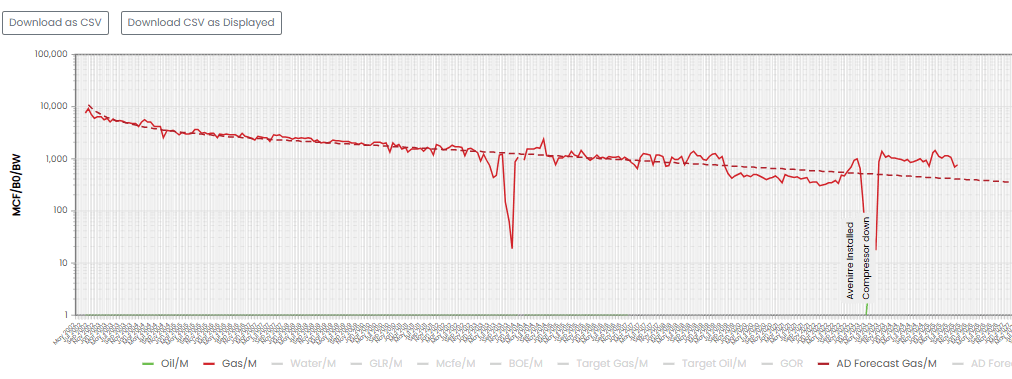
    A critical question is to ask: How much SHOULD a well be producing?  Decline curve analysis provides important insights, but only when interpreted carefully. A practiced and keen eye can learn to interpret decline curves so that you are seeing a true reservoir signal versus those wells that are sub-optimized. A curve may appear stable in the short term while masking significant underperformance. In the case of this example well below, production was consistently below reservoir capability until plunger lift was added in 2022.

    These insights help to shape your real production targets. For wells operating below their theoretical optimum, it is important to begin asking “why” ideally during wellbore reviews, or sooner.

  • Software Silos Slow Teams Down

    I’ve lost count of how many times I’ve watched good people waste hours moving the same numbers around in different systems. The field emails a spreadsheet, engineering keys it into their database, and accounting copies it into another. By the time everyone’s “in sync,” the decision moment has stalled.

    It’s not that the tools are bad. Each department has its favorite. But when every team guards its own island of data, the company pays the toll in slow cash-flow decisions and missed chances.

    Here’s a picture: Accounting sees a well that looks healthy on paper. Engineering knows the same well is a problem child in the field. Without a shared view, nobody connects the dots. Blind spots like that turn into expensive mistakes.

    And then there’s the busywork we stop noticing such as manual reconciliations, duplicate reports, and spreadsheet gymnastics that eat up entire afternoons. They hang around so long they feel “normal.”

    A single source of truth doesn’t just cut clutter. It changes the pace of the whole team. Decisions get faster. Problems surface sooner. Everyone sees the same story.

    Change is constant, but clarity is optional. The operators who choose it will move ahead. Want to see how Avenirre does it in practice? Let’s schedule a short walkthrough. Avenirre.com

  • Don’t Replace People. Make Them 10x Faster.

    I want to get something off of my chest. I have noticed that too many leaders chase Automation as if efficiency alone were the goal. It isn’t.

    Automation cuts people out. Augmentation makes them more capable. One deletes experience; the other compounds it. In oil and gas, that distinction decides who gets better and who just gets cheaper. You don’t need software deciding which well to shut in. You need it to handle the tedious parts, such as collecting data, doing the math, and flagging outlier wells, so your employees can do the thinking that actually moves the needle.

    The thought process is simple. Automate repetition. Augment judgment. Let code do the grunt work and let people make the calls that still depend on context, risk, and experience.

    When both align, output scales without burnout. Decision cycle times drop. Error rates fall. Profit per employee-hour rises. Trust grows because the system explains itself. That’s how improvement happens, not by replacing people, but by giving them superpowers.

    Want to see how Avenirre does it in practice? Let’s schedule a short walkthrough. https://avenirre.com/

  • How Data Reveals What Your Gut Misses

    Margins are tight. Teams are lean. Everyone’s working hard, yet not everyone’s equally productive. After decades in the oil patch, I’ve noticed a few operators consistently outperform the rest. Their secret? Not necessarily more effort but better focus, better tools, and better judgment about what actually moves the needle.

    The others? They’re stuck guessing. Guessing where the LOE bloat hides. Guessing which wells are quietly hemorrhaging cash. Guessing who should be doing what.

    But it doesn’t have to be guesswork.

    Data-driven thinking connects the dots from the field to engineering to accounting to the owner’s desk. It exposes systemic inefficiencies: uneconomic wells that should be shut in, legacy tasks no one questions, bloated LOE that slip through the cracks. With the right digital processes, you stop reacting and start anticipating.

    Productivity doesn’t come from working harder. It comes from seeing smarter. That’s what separates the high performers. Your wells already know the answers. If you’re listening, they’ll tell you where the money’s is being made and where it’s quietly leaking away.

  • The Real ROI of AI Minutes Saved

    Engineers used to call it the “Knack”, that mix of critical thinking, questioning, and a relentless respect for real world results. Tools have always been part of that craft. Slide rules gave way to calculators and then computers, and now AI is the next instrument on the workbench.

    Think of AI as a faster calculator. Same goal, shorter path. A calculator won’t design a bridge for you, but it will display the options so you can focus on the design. You still need to frame the problem correctly and validate that the answer makes sense. AI’s value today is in speeding up work we already know how to do: imagining possible solutions, reconciling mismatched data, or drafting workflows.

    But like a calculator, AI doesn’t replace judgment. Guardrails matter: human review, provenance, and versioning. You should always ask: Where did this idea come from? Implement versioning to trace how ideas evolve. Can I trace its logic? Does this idea make sense?

    The return on AI is easy to measure. Minutes saved × frequency × labor rate = ROI. AI is not magic, it’s leverage. Treat it like a calculator, useful, fast, but only as smart as the engineer pressing the buttons.

    Use AI as the sophisticated tool it is. Apply engineering discipline. Question everything. Let reality be your validator. The Knack still matters.

  • AI and the Work That Still Belongs to Us

    A hammer doesn’t build a house. People do.

    AI is a new tool for our toolbelt. It can spot patterns, draft options, surface blind spots, but it needs direction. Our work still leans on judgment, context, and the hard won sense for what matters most when money and safety are on the line.

    I am finding use cases for AI that I am using daily. My biggest win so far is simple. I use AI to read long technical material and hand me a tight brief. It pulls out what’s signal, not noise. I check the sources, compare against reality, and decide. The time saved pays for itself.

    A starter workflow you can copy this week:  

    Have AI summarize the document in question.  

    Extract the key takeaways, including options and tradeoffs.  

    Have AI ask you clarifying questions, or maybe “What questions do I need to be asking?”  

    Spend less time wading through pages and more time choosing the next move.

    AI is a power tool. Treat it like one. Keep your hands on the blueprint.

  • From Fire Drills to Smart Analytics

    Remember the pre-SCADA days? When your boss called asking why production and revenue tanked, triggering the dreaded “fire drill.” Production engineers frantically dialing field superintendents. Pumpers scrambling to check offline wells. Reservoir engineers buried under stacks of decline curves, hunting for underperformers like detectives at a crime scene.

    Those reactive days are over.

    Modern workflows aren’t about replacing good people—it’s about transforming how they work. Your field expertise remains invaluable, but now it’s amplified by rapid analytics that are ready when you need them. No more fire drills. No more manual decline curve archaeology.

    Picture this: real-time alarms for both production drops AND decline curve anomalies. Your computer buzzes with precise data before your boss even notices the problem. Financial modeling, once reserved for corporate teams, is now mainstream and accessible.

    The magic happens when good judgment meets best-in-class data. That combination? It delivers the best decisions—every single time.

    We’ve moved from reactive fire fighting to proactive well optimization. Your experience guides the strategy, while intelligent analytics handle the heavy lifting. The result? You stay ahead of problems instead of chasing them.

    The future of production optimization isn’t just automated—it’s intelligent.

  • Digitization was step one. AI is step two. Did your business keep up?

    When I started in the oilfield, engineering meant pencils, paper decline curves, and chasing data by hand. It wasn’t glamorous, but it was the only way.

    The last twenty years changed everything. Half of all digitization has happened in that short span. Workflows that once dragged on for days now finish in hours, sometimes minutes. That’s not a minor upgrade, it’s a reset.

    The digital methods aren’t just faster, they’re better. Cheaper. More consistent. They exposed that the old manual grind was slow and expensive.

    Operators who see this are already changing how they run their businesses. They’re not treating digital as a side project. They’re making it the core.

    The payoff is real. Lean, modern operators can post profits even when prices slump. Their competitors, stuck in old habits, can’t.

    In my opinion, that’s the line between staying in the game and fading out.

  • Passing the Torch Without Passing a Burden

    Early in my career, my focus was on the effort required to become a strong provider. Today, I think more broadly about building and protecting a legacy for the next generation. Every family oil and gas operator hopes to pass down their hard-earned assets. But the reality is this: if those assets are complex, poorly documented, or reliant on one person’s memory, they become liabilities rather than strengths.

    The challenge for the next generation is steep. They must quickly learn how the business truly operates while avoiding costly mistakes. Without a clear, accessible knowledge base, even the best assets can feel overwhelming.

    That’s where Avenirre makes a difference. We eliminate silos between production, finance, reserves, and operations, creating a single source of truth. This allows successors to step in with confidence, supported by built-in analytics that provide clarity, foresight, and actionable insights.

    Instead of struggling to absorb decades of expertise overnight, the system does the heavy lifting, empowering them to make informed, data-driven decisions that preserve and grow the business. Passing on your wells should also mean passing on a thriving, manageable operation and ensuring your legacy endures.

    Want to know more? http://www.avenirre.com

  • Engineering in the Age of Thinking Machines

    Have you tried AI yet? You should. Engineering is entering a new era where machines don’t just calculate. Thinking machines will create new augmented workflows that allow more to be accomplished in a single day.

    The skills that matter most will shift. Data fluency will become a baseline requirement, much like spreadsheets are today. The real premium will be on judgment: knowing which problems matter, framing the right questions, and making sense of trade-offs when algorithms give multiple paths forward. Communication skills will be paramount as engineers must translate machine insights into strategies that leaders, regulators, and communities can trust.

    What won’t change? The fundamentals. Physics still governs reservoir flow. Safety and reliability remain non-negotiable. And the drive to explore, build, and solve problems will only become more important as machines take on repetitive tasks.

    Finally, most of your profits from AI will not come from your famous cooking class essays, but from AI constantly analyzing your business using your own unique business model. Decision analysis or new business strategies can be stress tested against strip pricing and your current portfolio of properties, sharpening both strengths and exposing weaknesses.

    In short, thinking machines won’t replace engineers. But they’ll amplify the ones who learn to harness them.

  • What If Your Wells Could Explain Themselves to the Next Generation?

    I think a lot about the next generation these days. At the beginning of my career, knowledge was stored in memory and on paper. When the time comes to pass your oil & gas business to the next generation, you’re not just handing over assets, you’re also handing over decades of hard-earned knowledge.

    What is better now? Knowledge can also live in a system. Without that knowledge, your heirs inherit a puzzle with missing pieces.

    Imagine instead that your wells could talk and tell the next generation exactly how they perform, what they cost, what they produce, and where to focus for growth.

    That’s what an advanced digital system does. It pulls together production, financial, and reserves data into a single source of truth. Analytics turn raw numbers into clear guidance, so your successors can understand the business on day one without guessing, scrambling, or dependency on tribal knowledge.

    Legacy should be more than a hand-off. It should be a launchpad for the next generation to build on what you created. With a system of data gathering and analytics, your wells don’t just produce oil and gas, they produce insight.

    Because the best gift you can give your successors is the ability to run the business with confidence.

  • Passing O&G Assets to the Next Generation

    Is it your dream to pass on your hard-earned assets to the next generation? You’re not alone. Every Family operator faces this same challenge, that is: how to build something that lasts beyond your own career.

    Our legacy becomes more important as time passes. What started as a simple business has transformed into something much bigger. You’re not just managing wells today. You’re creating tomorrow’s foundation for your family.

    What this means is that the next generation will have a head start if you build smart systems now. The difference between success and struggle often comes down to one thing: how efficiently your operation runs when you’re not there to watch every detail.

    Here’s what to do. Think about how to cut operating costs at every step from the wellhead to the revenue check. Reduce overhead expenses and weigh the true cost of data collection. Does automated monitoring save more money than field personnel will cost? Can you automate administrative tasks that eat up valuable dollars? Every dollar you don’t spend on unnecessary operations is a dollar that stays in your family’s future.

    Start today. Your legacy depends on the choices you make right now.

  • 3 ways to deal with low oil prices

    Here we go again, oil prices have dropped significantly. Have you reacted? Here are three ideas.

    • First respond to lower prices by stopping the bleeding
      • Do you have any uneconomic wells? Are you sure?
      • Avenirre makes the calculations easy. Even those “hidden” wells inside a large unit.
      • Create a list of wells that will be shut in at a certain commodity price.
    • Second, get ready for higher prices surely to come.
      • Improve your property portfolio via acquisitions/divestitures
    • Third, make a plan to succeed.
      • Rapidly changing commodity prices keep you guessing, use scenarios to gamify.
      • Use facts: not gut feelings to drive decisions.
      • Seize the opportunity to remake your organization into a leaner company
      • Don’t ignore HBP issues. Set up an alerting system.
      • Group wells by pumper routes for additional insights.
      • Make company efficiency a main driver going forward
      • Consider using software to handle the everyday work

  • I feel the need for speed

    Said Goose in the movie Top Gun. Likewise, Reservoir engineers face a near impossible task: make speedy forecasts that hit financial targets dead-on.

    Sounds simple. It’s not.

    The culprit? The Visibility Gap.

    Back in the 1980s, I watched this gap destroy forecasts. Current production data was unavailable or disconnected from aged accounting numbers. Downtime anomalies created noise. Financial clarity remained elusive.

    Four decades later, the same problem haunts some operators.

    Here’s the brutal truth: Many companies still forecast like it’s 1985.

    Digital technology can close this gap completely. Real-time operational data connects seamlessly with live pricing. Yet operators cling to outdated methods that guarantee inaccuracy.

    The stakes have never been higher. With oil prices driving marginal economics, slow forecasts kill profitability. Decision makers need instant financial guidance, not month-old data.

    Two factors separate winners from losers:

    • Real-time operational visibility
    • Live pricing integration

    The math is unforgiving. Accurate forecasting demands both.

    Your survival checklist:

    • Embrace digital transformation
    • Demand real-time accuracy
    • Make economics drive every decision

    The visibility gap isn’t inevitable. It’s a choice.

    Stop flying blind.

  • Lessons from Past Energy Crisis

    • How do you define a business crisis? How about this: Whenever commodity prices drop significantly enough to pressure your profit margin. Or, whenever economic pressure is enough to threaten the status quo of your business. When it hurts. You feel it. Maybe it’s happening now. If you find yourself in a crisis, what do you do?
    • Here is what has worked in the past.
    1. Embrace that a crisis forces a rethink and justification of your business processes.
      Is it time to ask: Why do we monitor and report production and expenses like we do? Is there a better way?
    2. A staff reduction may be needed.
      The US Bureau of Labor Statistics notes that total employment in Oil and Gas extraction has declined by 46% in the last 40 years. (https://fred.stlouisfed.org/series/CES1021100001) Yet the industry managed to grow production during that time.
    3. Improve your well portfolio.
      Wells deplete, and water cuts increase. The trend may not be your friend. lt may be time to cut loose those marginal wells.
    4. Improve your focus on revenue and expense management.
      Are you suspicious that some of your oil is disappearing with water hauls? Have you ever found duplicate invoices that were paid?
    5. Why not regularly rethink your business?
      • Conclusion:
        Short term: Focus on workflows and expenses first for quick wins. Is it time to bring in new technology with digital workflows and automation?
        Long term: Focus on portfolio management.
        Rethink every key part of your business.
        Don’t let a crisis go to waste. You are in the business to make money, not volumes.
  • 7 Common & Expensive Industry Mistakes

    I have enjoyed a front row seat to the workflows of people actually managing Oil & Gas assets. Often, I see many companies suffer from economic underperformance. Here is my list of Common & Expensive Mistakes.

    1. Chasing production volumes instead of revenue.
    Comment: You are in the business to make money, not hydrocarbons.
    2. Infrequent wellbore reviews delay the scrutiny of problem wells.
    Comment: The work required to create the review documents is daunting. But what is the cost of not doing wellbore reviews? Could you use automation as a shortcut?
    3. Expecting pumpers to Identify & Respond to problem wells.
    Comment: It takes a broad perspective to prudently invest resources.
    4. Adding expensive staff instead of cost effective digital processes.
    Comment: It’s economics at this point.
    5. Drowning in unanalyzed data without a plan or tools.
    Comment: Think of your data as the newest resource play, and your perspective changes.
    6. Allowing uneconomic wells to hide inside large units.
    Comment: Have you ever seen this?
    7. Being blind to adverse operating expense trends.
    Comment: Imagine if you could rapidly create a visual analysis.

    These costly missteps are common but can be addressed with the right tools and mindset. If you’re ready to rethink your workflows and put your data to work, let’s talk about how Avenirre can help you run leaner, smarter, and more profitably.

  • Oilfield Supermodels

    No, not THAT kind of Supermodel. Modeling was not practical early in my career. Prior to computers, manual computations would have taken too much time away from other priorities. With computers, modeling has become a tool in our toolbelt. Models allowed economics of a waterflood or creative drilling scenarios to be run digitally first, vastly improving economic planning scenarios.

    Is your company struggling to achieve sufficient profitability? How could a Supermodel of your company help?

                   Good: An annual budgeting spreadsheet is really a simple financial model of your company.

                   Better: Using the 3-year price strip, model if it’s better to add gas or to add oil volumes with capital. Compare go forward plans with and without the divestiture of the marginal wells you now own.

                   Best: Auto-create an unbiased Supermodel with forecasts that include pricing. Set accountability for staff with frequent wellbore reviews using autogenerated reports. Update your workflows to track economically driven decision making, then outsource the updating of the models to the cloud. Refine your model as new history appears.  Locate the key profitability drivers of your business.

    Don’t have time to do this? Then fix your daily processes first to free up time for more strategic planning.

    Conclusion: Business is challenging, but a digital twin will allow a test drive first.

  • This time it’s different

    Let’s face it, most operators have insufficient profits from their business much of the time.  Being an operator is humbling because it is hard to execute well, even in good times. There is a bumper sticker in Midland, Texas that reads: “This time it’s different”.  It’s a sarcastic warning to the oil field to not be reliant on high oil prices.

    I keep a spreadsheet of inflation adjusted oil prices. Since 1970, the average is $55/bbl (medium $49/bbl). Which begs the question: How on earth can you sleep well at night thinking that $55/bbl might be in your near future?

    Here’s how:

    1. Take a good hard look at your business. How do you keep the lights on? Which wells would be profitable at $55/bbl?  Which pumpers would you release?

    2. Then, right size your overhead by modernizing your workflows to thrive even at prices lower than today’s price of $64.31/bbl.

    3. Use price dips to opportunistically upgrade your well portfolio. Fact: Your current well completions are finite and will eventually be depleted.

    4. Consider balancing your company’s oil vs gas ratio. There may be more price upside for natural gas.

    5. All else being equal, acquire longer lived properties.  This means that lower permeability rocks are your friend.

    The price outlook appears challenging, but maybe the challenges are opportunities in disguise?

  • Facial recognition software for Cows


    What kind of world are we living in now? As it turns out, a changing kind.  Just imagine, the next generation of kids may grow up not knowing much about pennies.

    So much has changed over the course of my career. No joke: feedlots can now use facial recognition software to identify individual cows to track their weight and food consumption. Also not a joke: Amoco Production Company employed skilled draftsmen to hand plot monthly lease production values on graph paper so that I and the other petroleum engineers could hand draw decline curves.

    Here is what I got wrong: I never thought that the world would change as much in my life as it has. For the first time in our lives, we have access to unlimited and inexpensive cloud computing and storage.  A data center is about to be tested on the Moon to take advantage of the super low cooling temperatures. Wow.

    There are new realities in the digitized oilfield. Now, we can digitally obtain all the information we need faster and on demand.  Avenirre, a software company that I co-founded takes advantage of all of this and more.

    Change is constant, and we are better off for it.

  • Intro to Larry’s Energy Insights

    After more than four decades of being a petroleum engineer in the oil and gas industry, I’ve seen it all—booms, busts, innovation, and regulation. The energy landscape has changed dramatically since I first stepped into the field office of Amoco Production Company, but two things have remained constant: 1. Energy is the backbone of civilization and 2. Management of O&G companies is very hard to execute well. My name is Larry Brazile, and I am a petroleum engineer and co-founder of Avenirre, a software company dedicated to helping oil and gas operators improve their financial outcomes through enhanced production visibility and automated workflows. Today, I am introducing “Larry’s Energy Insights”

    I’ve seen how operators struggled with disjointed data, inefficient workflows, and inadequate financial transparency. Avenirre was built to bridge that gap, empowering companies to make data-driven decisions that enhance profitability.

    I invite you to join me on this journey. Whether you’re an industry veteran, a newcomer, or simply someone interested in the future of energy, I hope this blog will provide valuable insights and spark meaningful discussions. The best days of this industry aren’t behind us, they’re ahead. Let’s explore them together.